
Training session, course, pathway or programme – which is right for your organisation?
September 23, 2026
How to build a business case for a communication skills training programme
September 23, 2026FURTHER EXPERTISE
How to set up a communication skills programme: a step-by-step guide
Expert Opinion from Rich Watts published September 23, 2026
There is a significant difference between knowing that your organisation needs a communication skills training programme and knowing how to go about setting one up. For many HR managers and L&D leads, the gap between those two positions is filled with uncertainty: where do you begin, what does the process actually involve, and how long is it all going to take?
This guide sets out the process clearly, stage by stage. It is written to support the HR professional or L&D lead who is ready to move from recognising the need to actually commissioning and running a programme. It will help you to craft an effective solution by following a clear process.

GETTING STARTED
Before you begin: key decisions to be made
Before any conversation with a training provider, it helps to get clear on three things. They do not need to be resolved in detail, but having a working answer to each will make your conversations sharper and more productive.
- What is the development need? Not just 'we need better communication'. That is a direction, not a brief. What are your people currently doing, and what would you like them to be doing differently? For example, is the issue in how managers give feedback, how they handle difficult conversations, how they communicate change? The more specific you can be, the more targeted and effective the programme will be. If you are not yet sure, a training needs analysis (which is covered in Step 1 below) will help you to get there.
- Who is the training for? The audience shapes the design of training at every point. It will influence the examples used, the complexity of the scenarios explored, the language and register of the facilitators. A programme for new managers moving into their first people responsibilities will be very different from one designed for a senior leadership team. Being clear about the audience early avoids the most common pitfall in L&D commissioning: a programme that tries to be all things to all people and ends up being useful to none of them.
- What does success look like? If the programme works, what will be different? How will you know? Establishing some sense of the expected outcome before you begin is so important. It shapes the design, it informs the measurement approach, and it makes it possible to demonstrate the value of the investment to the people who signed it off. We will come back to this in Step 6.

Discover more about our Communication Skills Programmes
GETTING IT DONE
The seven stages of setting up a communication skills programme
Ok, buckle up, this is the really useful practical bit about how to set up a communication skills programme successfully.
Step 1: Conduct a training needs analysis
A training needs analysis is the research phase that connects the broad development need to a specific training response. It involves gathering data from the people who will participate in the programme, usually through surveys, interviews, observation, or a combination of all three, to build an accurate picture of what is going on. You will usually discover the current capability baseline, the specific skill gaps, and the contexts in which people are finding communication most challenging.
A good needs analysis does not always just confirm what you already suspect. It may surface the real challenges or needs underlying what has been asked for. Understanding these hidden things can is key to creating the most useful, relevant learning solution. It might reveal, for example, that the primary challenge for your managers is not the difficult conversation itself but the avoidance of it. That distinction changes the design of the programme and solution.
If you would like a more detailed guide to this stage, our article on how to identify your organisation's communication training needs covers the full process, including the methods and questions that produce the most useful data.


Step 2: Write a clear brief
The brief is the document that translates the findings of the needs analysis into a document that can be given to potential providers and allow them to create a solution for you. It does not need to be long, two to four pages is usually enough, but it should cover the essentials: who the programme is for, what the development need is, what success looks like, any constraints on format or timing, and the budget range you are working to.
A well-written brief makes the conversations with potential training providers significantly more productive. It allows providers to come back to you with proposals that are tailored to your situation rather than off-the-shelf programmes with your organisation's name attached. And it gives you a clear basis for comparing what different providers are offering.
It is also worth including in the brief anything you know about the culture of the organisation and how it typically responds to training. This context helps a good training provider design a programme that is genuinely suited to your situation.
Step 3: Choose the right training provider
The right training provider for your organisation is not necessarily the biggest or the most well-known. It is the one whose approach, style and values fit your culture, whose expertise is most relevant to your brief, and with whom you feel confident that the relationship will work.
When you are evaluating potential providers, the questions that tend to be most revealing are about specific experience and track record. Ask for examples of similar work they have done, including what the brief was, what they designed, and what the outcomes were. Ask how they approach the needs analysis phase and what they do if the findings differ from what the brief anticipated. Ask what they do to support the transfer of learning after the training itself.
It is also worth reflecting on how the conversation feels. A provider who listens carefully, asks good questions and challenges your assumptions constructively is likely to design a better programme than one who moves quickly to present a solution before they have fully understood the problem.

Step 4: Co-design the programme
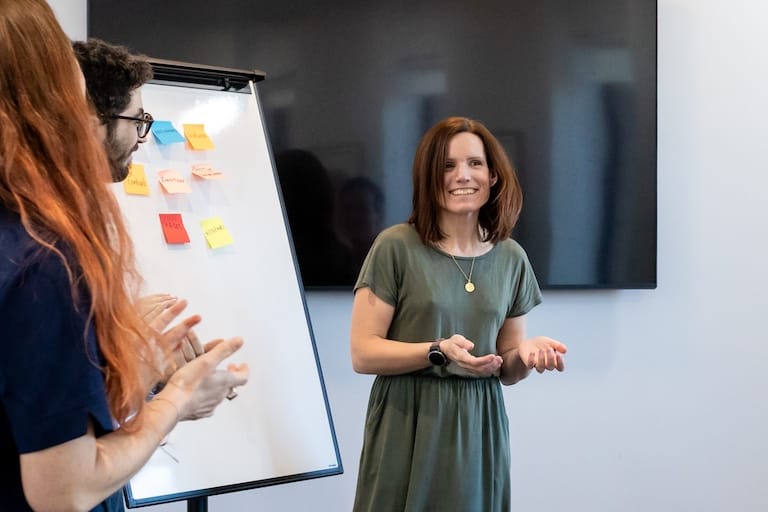
The best communication skills programmes are designed collaboratively. That does not mean the organisation has to do the creative work (that is the training provider's job!), but it does mean that the organisation is an active participant in the design process rather than a passive recipient of a proposal.
In practice, co-design typically involves one or two working sessions between the HR lead and the training provider to agree on the structure of the programme, the content of each session, the balance between input and practice, and the overall arc of the learning. It may also involve the training provider spending time with a small group of participants before the design is finalised so that the scenarios and examples used in the training feel genuinely real rather than illustrative.
If you are still working out what a programme should cover, our guide to what to include in a communication skills training programme sets out the content areas and design decisions in detail.
Step 5: Prepare the organisation and the participants
A communication skills programme really begins the moment that the participants hear that it is happening. How the programme is communicated to the people who will take part in it has a significant influence on how seriously they take it and how much they invest in it.
The most effective preparation involves a message from a senior leader that explains why the organisation is investing in this development, what it is hoping to achieve, and why it matters. Participants who understand the purpose of the training and feel that it has genuine organisational backing are considerably more engaged than those who experience it as a box to be ticked.
It is also useful to set expectations clearly: what the sessions will involve, how much time they will require, and what is expected of participants between sessions.


Step 6: Deliver the programme and support transfer
Delivery is the stage most organisations focus on as the quality of the facilitation matters enormously. But the single biggest factor in whether learning transfers from the training room is what happens afterwards.
The most effective programmes build in structured opportunities for participants to apply what they have learned in real situations and to reflect on how it went before the next session. This might take the form of a short observation or peer debrief exercise, a guided reflection question, or a specific communication challenge set between sessions. Whatever the method, the principle is the same: learning that is tested in real conditions and reflected on deliberately is more likely to stick than learning that is left entirely to participants to apply in their own time.
Individual coaching, where it is part of the programme, plays an important role at this stage. A coaching conversation between sessions gives participants a confidential space to work through the specific challenges they are encountering as they try to apply the new skills.
Step 7: Measure the impact
The best measurement is a considered part of the programme from beginning to end. Data that makes it possible to demonstrate impact needs to be gathered before the programme begins, so that there is something to compare the post-programme data against.
The measurement approach will depend on what you established as success criteria in Step 1. At minimum, a well-run programme should produce participant self-report data showing how confidence and capability have shifted across the skill areas covered. At its most robust, it will also include line manager observation data and, where relevant, qualitative evidence of how communication in the organisation has changed in ways that are visible to the people who work in it.
For a detailed guide to building a measurement framework into your programme from the outset, see our article: how to measure the impact of a communication skills training programme.
CASE STUDY
How this process worked in the real world: The Soil Association
When Further Communications began working with the Soil Association, the starting point was a clear organisational need. The communications team were going through a period of significant change and needed support with how they communicated through it. However, the precise shape of the training need was not yet fully defined.
Further's approach was to begin with a structured needs analysis: a series of conversations with key members of the team to understand the specific communication challenges they were navigating, the contexts in which those challenges were most acute, and the outcomes they were hoping to achieve through the programme. That research informed both the content and the structure of the work that followed.
Rather than delivering a standard programme, the training was built around the specific circumstances and language of the Soil Association's team. The scenarios used in sessions were drawn directly from situations the participants were facing, which made the learning feel immediately relevant and practical rather than theoretical. The result was a programme that participants engaged with fully because they could see, from the outset, that it had been designed and tailored for them.
GOING FURTHER
Related reading from Further Communications
If you have not yet completed a training needs analysis, our guide to identifying your organisation's communication training needs is the right place to begin.
For guidance on what a communication skills programme should cover, our article on what to include in a communication skills training programme sets out the content areas and the design decisions in detail.
Not yet sure whether you need a full programme or a shorter intervention? Our guide to the differences between a training session, course, pathway and programme will help you work that out.
If you need to make a case to the business for this investment first, the next article in this hub covers how to build a business case for a communication skills training programme.
To see the full scope of Further's approach to programme development, visit our communication skills programme development page.


HOW FURTHER COMMUNICATIONS CAN HELP
Ready to start? We can guide you through every stage.
Further Communications works with HR leads and L&D professionals to design and deliver communication skills programmes that are grounded in a proper understanding of the organisation's needs and built to produce real, measurable change.
Whether you are at the very beginning of the process and still working out what you need or you ready to commission, we would be happy to talk and support you.
Or get in touch directly — we will get back to you within one working day.