Communication skills programme development for UK organisations
We develop unique programmes designed to give your people the exact communication skills that they need to succeed in their roles.
Programmes that develop your people into supercommunicators...
Developing the skills to overcome the biggest communication challenges within an organisation often takes more than a single training day.
Truly solving the problem and giving your people the skills to succeed in the years ahead requires something more structured, more sustained and more measurable. Something you can present with confidence to your senior leadership team and see results from twelve months later.
That is exactly what Further builds. Working with HR managers, L&D leads and senior leaders across the UK, we design and deliver bespoke communication skills programmes that are tailored to your organisation, built around the real skill gaps your people face and measured properly so you can demonstrate the impact.
From a structured series of in-house courses to a full multi-stage development pathway with coaching, resources and more, we will design the programme that is right for your organisation and then deliver it to the highest possible standard.
IS A PROGRAMME THE RIGHT APPROACH?
A communication skills programme is the right choice when a single training day is not enough
Standalone training days are valuable, and for many organisations they are exactly the right starting point. A communication skills programme is the right next step when the challenge is bigger, more sustained or more strategic than a single session can address.
- You want to develop communication skills across a cohort of managers or leaders over a period of months, with learning that builds progressively.
- You are building or formalising an L&D function and want a structured, credible communication skills offering that you can embed into your organisation's development pathway.
- You have identified a significant communication challenge. For example, a culture that avoids difficult conversations, managers who struggle to lead change, meetings that consistently fail to produce decisions, and you need a sustained intervention rather than a one-off fix.
- You need to be able to demonstrate the ROI of your L&D investment to senior leadership, and that requires proper measurement before, during and after the programme.
- You want your managers to develop a common language and a shared set of communication skills that they can apply consistently across the organisation.
- Individual courses have addressed specific skill gaps, and you are now ready to bring those skills together into a joined-up development programme.
WHAT A FURTHER PROGRAMME LOOKS LIKE
A programme built around your organisation, not a standard template
No two Further programmes are identical, the content, the format, the sequencing and the timescale are all designed around what your organisation really needs.
What is consistent across every programme we deliver is the approach that we take: deep research at the start, subject matter experts in every session, meaningful measurement throughout and genuine support between sessions.
A communication skills programme might combine any of the following, in a sequence and at a pace that suits your organisation and your people.
In-house training days
Expert-led, tailored group sessions covering specific communication skills. Delivered in person or online. Each session is built around your organisation's scenarios and challenges.
One-to-one coaching
Individual coaching sessions that go deeper on personal development goals, specific upcoming challenges or communication skills that need focused individual attention.
Action learning sets
Facilitated peer learning sessions where participants work through real communication challenges together, supported by an expert facilitator. Particularly effective for embedding learning between group sessions.
Self-directed learning
Curated resources, frameworks and reflective exercises that participants work through between sessions, at a pace that fits around their working lives.
Follow-up and embedding
Structured follow-up is provided after each session, including individual feedback, coaching access and learning emails. All designed to keep the skills developing between the more formal training moments.
Measurement and reporting
Confidence, understanding and competence are measured at agreed points throughout the programme and reported in a clear, readable format that demonstrates progress and impact. You will always know how the programme is going and be able to demonstrate its impact.
WHAT A FURTHER PROGRAMME DELIVERS
What organisations typically achieve through a communication skills programme
The outcomes vary depending on the focus of the programme, but these are the results that Further's programme clients most consistently report.
- Managers who have a shared language and a consistent approach to communication across the organisation
- A measurable increase in confidence and competence in the specific communication skills the programme addresses
- Difficult conversations that actually happen, rather than being delayed or avoided
- Meetings that produce clear decisions and agreed actions rather than discussion without resolution
- A management team that is better equipped to lead through change and maintain trust during uncertainty
- Clear evidence of impact that can be presented to senior leadership and used to justify further investment in communication skills development
- The foundations of a credible, sustainable L&D function — even for organisations building one for the first time

From first conversation to measurable results: the Further process
Every programme we design follows the same five-stage process. It is designed to make the whole experience as straightforward as possible for you, while ensuring the programme we build is genuinely the right one for your organisation.

1. Research
We invest time in properly understanding your organisation before designing anything. This means conversations with you and your team, surveys of the people who will be on the programme, and a clear picture of the challenges, skill gaps and goals you are working with. The research phase is what makes everything that follows so relevant and effective.
2. Design
Using what we have learnt, we design a programme that addresses your specific challenges in a format and sequence that will work for your people. You will see and review the full design before anything goes into delivery. You will also meet the subject matter experts who will be leading each element of the programme.

3. Delivery
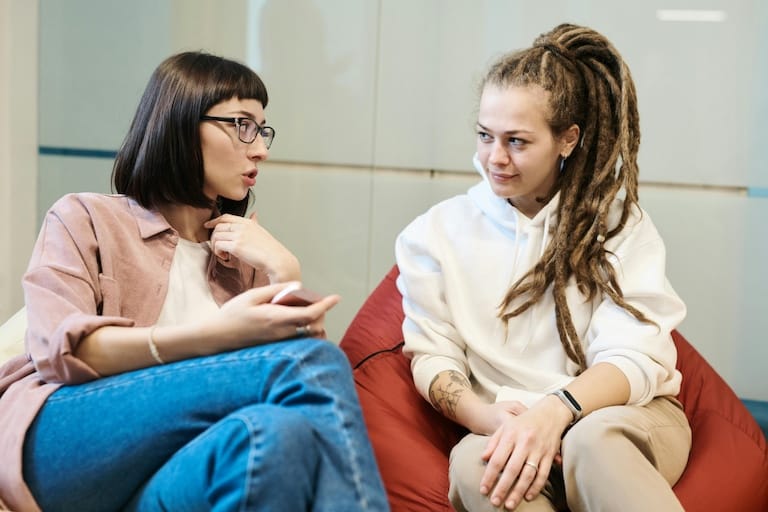
Sessions are delivered by the right expert for each topic. They are people who have spent their careers developing deep expertise in a focused area of communication, not generalists who cover everything. Throughout delivery, we stay in regular contact with you and the learners, checking in on progress, coaching and adapting the programme to respond to what is emerging.
4. Measurement and reporting
We measure confidence, understanding and competence at agreed points throughout the programme, not just at the end. Progress reports are written to be clear, readable and easy to share with your senior leadership team. You will always know how the programme is going and be able to demonstrate its impact.


5. Refinement
The best programmes get better over time. Following each measurement phase, we review what the data is showing us and refine the programme content and format accordingly. An organisation that works with Further on a multi-year programme benefits from a solution that improves year on year.
THE COURSES THAT MAKE UP A PROGRAMME
Any of our courses can be combined into a tailored programme
Further's individual in-house training courses are each designed as standalone sessions, and many organisations begin there. They can also be combined into a structured programme that builds skills progressively and addresses several communication challenges within a single, joined-up learning pathway.
The courses that most commonly feature in our management communication programmes are listed below, along with the specific skill gaps each one addresses. Every combination is tailored to your organisation's priorities and your team's starting point.